
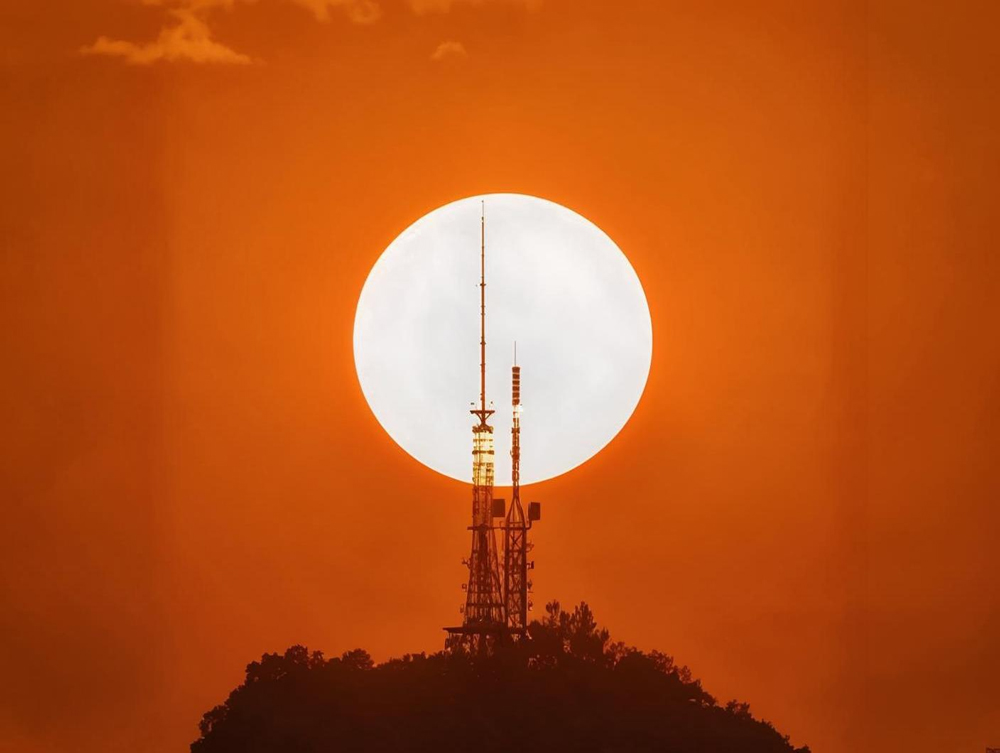
Radio waves do not care about roads, oceans or mountains; they simply obey Maxwell’s equations. Yet the same 5 W handheld that reaches 30 km across open water may die 500 m inside a concrete hotel. Bridging that gap is the art and science of long range communication.
The electromagnetic path
At VHF (136–174 MHz) wavelengths of roughly two metres, diffraction lets the signal curl over hills, giving rural users excellent long range communication. UHF (400–520 MHz) half-metre waves slip through windows and rebar, making them the urban choice even though free-space loss is 8 dB higher. Above 700 MHz, penetration improves further, but foliage and human bodies add 15–20 dB/km attenuation, limiting handheld-to-handheld links.
Analog and digital bricks in the wall
Traditional FM is simple, but 12.5 kHz analogue voice occupies precious spectrum and suffers from noise. Digital Mobile Radio (DMR) compresses speech to 2.4 kbps and slots two conversations into the same bandwidth using TDMA, effectively doubling the channel count without increasing interference—an elegant upgrade for any long range communication network. P25 Phase II does the same for North-American public safety, while NXDN keeps FDMA purists happy at 6.25 kHz.
Repeaters: the altitude multiplier
The Friis formula shows a 6 dB/octave advantage when height doubles; a rooftop or mountain-top repeater therefore turns a 5 W handheld into a 50 W “virtual” station. Properly engineered systems offset the 600 kHz VHF or 5 MHz UHF duplex spacing, add CTCSS/DCS access tones, and optionally link multiple sites over IP, creating seamless long range communication across provinces.
Licensing and regulation
The 409 MHz “ licence-free” band offers 20 pre-programmed channels at 0.5 W—perfect for family skiing but inadequate for commercial logistics. Amateur operators may legally run 50 W on VHF/UHF after passing an exam, whereas aviation (118–137 MHz AM) and maritime (156–163 MHz) allocations are strictly channelised and ship- or aircraft-licensed. Ignoring these rules invites both fines and harmful interference that degrades everyone’s long range communication.

Equipment families
• Handheld: 1–5 W, SMA/BNC whip; battery life dominant.
• Mobile: 10–50 W, magnet-mount or NMO roof antenna; cooling fan critical.
• Base/Repeater: 25–100 W continuous duty, duplexer cavity tuned to 0.5 dB insertion loss.
• Intrinsically safe (Ex ib IIB T4) versions swap aluminium chassis for copper-filled mouldings to quench sparks in petrochemical plants.
A volunteer search-and-rescue team might pair 409 MHz licence-free radios for line-of-sight dog handlers, add a 50 W VHF mobile on a ridge repeater for valley coverage, and integrate a DMR Tier III trunking gateway for encrypted long range communication back to the command post. Antenna height, coax loss (<2 dB/100 m at UHF), and digital forward-error-correction each give roughly 3–6 dB gain—doubling range or halving power.
Compared with its peers, ETMY radio leaves our factory with CE, FCC already printed on the label. IP68 sealing survives one-metre submersion, while sand, dust and drop tests ensure 1.2 m concrete survival. Our in-house RF anechoic chamber validates spurious emissions to within 0.1 ppm, guaranteeing clean long-range communication in congested spectrum. From surface-mount lines to automated optical inspection, we control the entire supply chain so that your next mission, expedition or fleet rollout enjoys uncompromising long-range communication—rain, dust, darkness or danger notwithstanding.