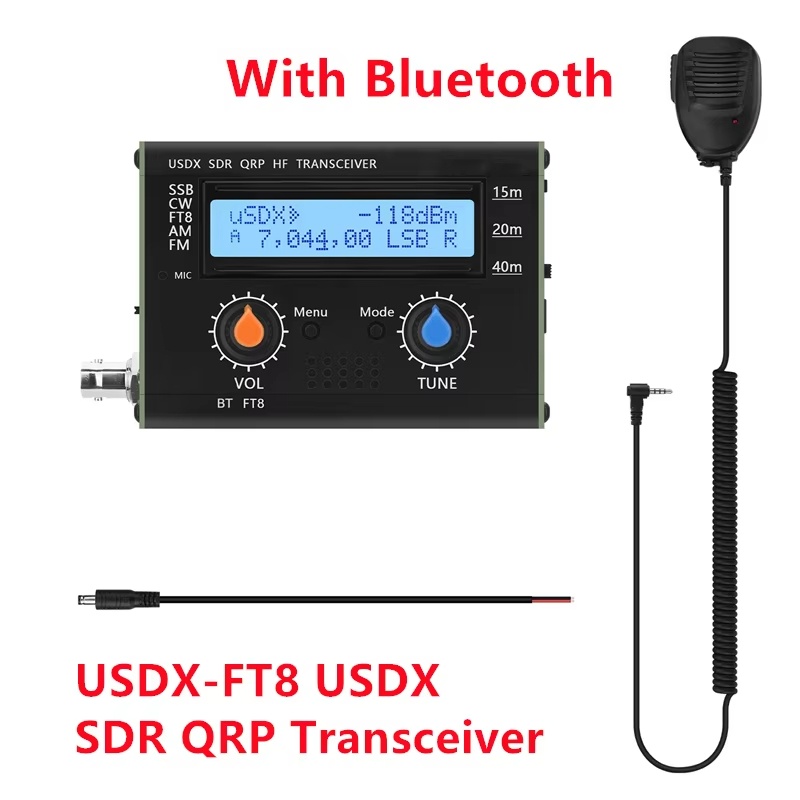
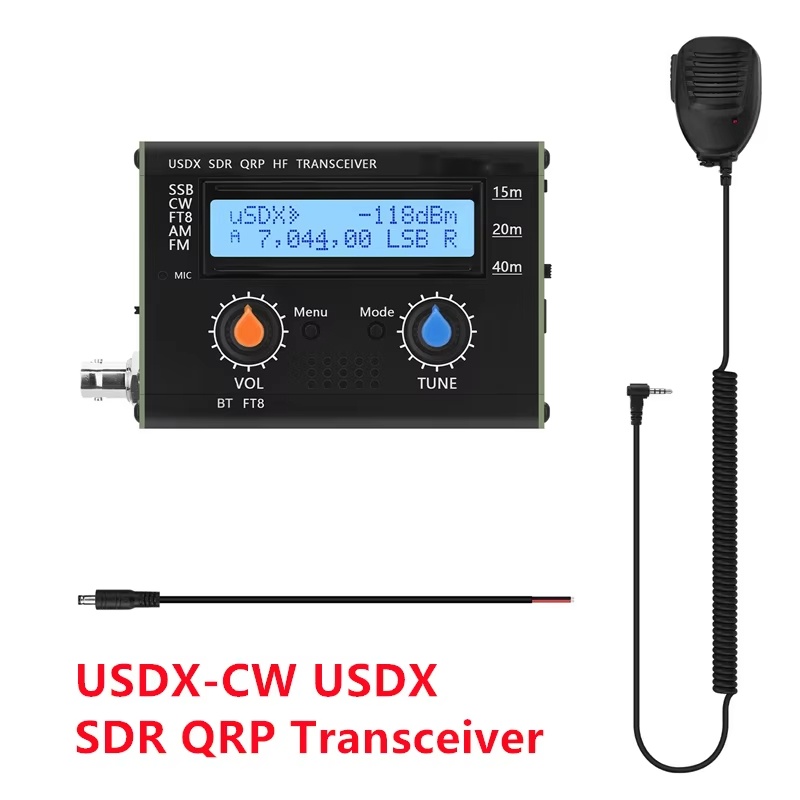
USDX-CW/USDX-FT8 5W usDX SDR QRP Transceiver QCX-SSB to SSB 15m/20m/40m 3-Band All Mode HF Transceiver With Bluetooth
Advantages:
* Less than 5W in 15m, 20m and 40m bands
* With a firmware upgrade interface. Through this interface, you can update the firmware for USDX-CW or USDX-FT8 transceiver
* With an aluminum alloy housing
* Later, the firmware of CW and FT8 versions can be flashed for each other
Attention:
* Menu 8.6 is the CAT data switch. Please turn it off when FT8 is not used.
* When the firmware is for CW version, please turn off the CAT data switch in menu 8.6 to avoid the screen displaying incomplete frequency text (mainly due to a bug in the firmware).
About Bluetooth:
* The CW and FT8 versions support Bluetooth.
* CW version: Turn off the Bluetooth function if you do not want to use it.
* FT8 version: Menu 8.6 CAT data switch should be turned on. At the same time, the radio in Bluetooth mode should be powered by the physical Bluetooth switch. In this way, the radio’s Bluetooth function can be used.
Description:
USDX SDR QRP transceiver is a 3-band HF transceiver. Using TCXO, its operating frequency stability is up to 0.5PPM. It is optimized and modified based on the open-source work uSDX/QCX-SSB. The open source URL is:
The USDX QRP shortwave transceiver operates in LSB, USB, and CW modes, covering the 40m, 15m, and 20m amateur radio bands. It has a power output of less than 5W and features a 1602 LCD screen. The casing is partially made of aluminum alloy. The dimensions are 10.05cm x 3cm x 7.5cm (excluding protrusions), with slight variations possible due to manual measurement.
Included as a bonus are AM, FM, and Bluetooth FT8 functionalities. Users can experiment with FT8, AM, and FM using a computer or mobile phone via Bluetooth. Please note that these bonus features are intended for entertainment and research purposes only and are not part of the product’s official specifications. Disputes related to these bonus features will not be entertained. If you do not agree with these terms, please refrain from purchasing this product.
The CW version supports LSB, USB, and CW modes but does not support FT8. The FT8 version includes AM, FM, and Bluetooth functionalities. Although the Bluetooth FT8 version does not display CW decoding, it still allows CW operation.For customers interested in both modes, please contact our customer service. We will provide firmware for both versions, and you can switch between them by updating the firmware.
The package includes the main unit, a power cable, and a hand microphone. A 12V power supply is not included.
List of Features:
* Simple, fun and versatile QRP SSB HF transceiver with embedded DSP and SDR functions
* EER class-E driven SSB transmit-stage
* Approximately 5W PEP SSB output from 13.8V supply
* All-mode support: USB, LSB, CW, AM, FM
* DSP filters: 4000, 2500, 1700, 500, 200, 100, 50 Hz passband
* DSP features: Automatic Gain Control (AGC), Noise-reduction (NR), Voice-triggered Xmit (VOX), RX Attenuator (ATT), TX noise gate, TX drive control, Volume control, dBm/S-meter
* SSB opposite side-band/carrier suppression transmit: better than -45dBc, IMD3 (two-tone) -33dBc, receive: better than -50dBc
* Open source firmware, built with Ar-duino IDE; allows experimentation, new features can be added, contributions can be shared via Github, software-complexity: 2000 lines of code
* Software-based VOX that can be used as fast Full Break-In (QSK and semi-QSK operation) or assist in RX/TX switching for operating digital modes (no CAT or PTT interface required), external PTT output/PA control with TX-delay
* Simple hardware design with only 4 ICs, a micro-controller and few transistors/passives
* Lightweight and low-cost transceiver design: because of the EER-transmitter class-E stage it is highly power-efficient (no bulky heatsinks required), and has a simple design (no complex balanced linear power amplifier required)
* Fully digital and software-based SSB transmit-stage: samples microphone-input and reconstruct a SSB-signal by controlling the phase of the SI5351 PLL (through tiny frequency changes over 800kbits/s I2C) and the amplitude of the PA (through PWM of the PA key-shaping circuit)
* Fully digital and software-based SDR receiver-stages (optionally): samples I/Q (complex) signal from Quadrature Sampling Detector digital mixer, and performs a 90-degree phase-shift mathematically in software (Hilbert-transform) and cancels out one side-band by adding them
* Three independent switchable analog front-end receiver attenuators (0dB, -13dB, -20dB, -33dB, -53dB, -60dB, -73dB)
* Receiver Noise floor MDS: –135 dBm at 28MHz (in 200Hz BW)
* Receiver Front-end selectivity: steep -45dB/decade roll-off +/-2kHz from tuned-frequency
* Blocking dynamic range: 20kHz offset 123dB, 2kHz offset 78dB
* CW decoder, Straight/Iambic-A/B keyer
* VFO A/B + RIT and Split, and corresponding relay band-filter switching via I2C
* CAT support (TS480 subset), possibility to stream audio, keys, display-text over CAT
* Optional SWR/Power measurement and PA efficiency/overload control
* Probably the most cost effective and easy to build standalone SDR/SSB transceiver that you can find. Very much simplified circuit and versatile in use
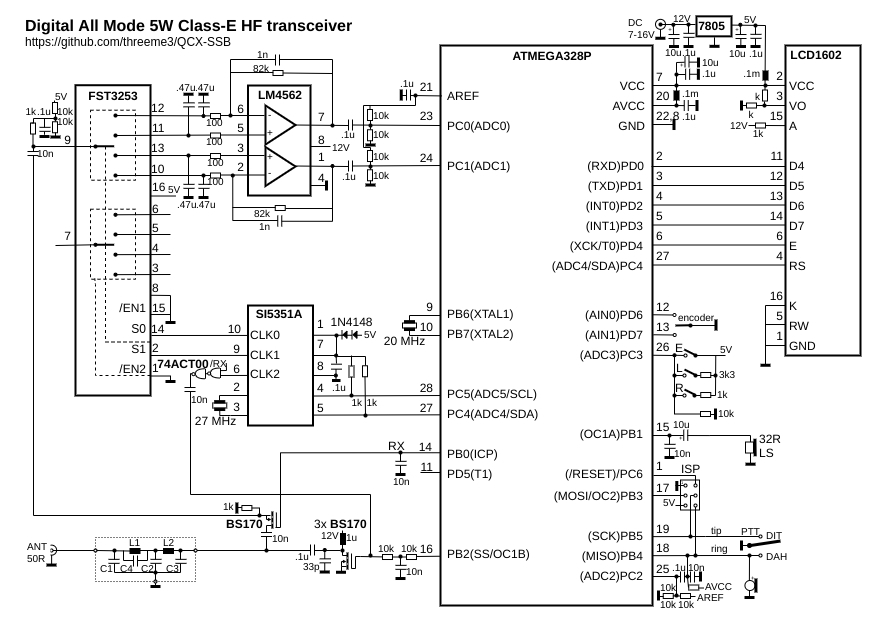
Schematic:
Specifications:
* Working voltage: DC 13.8V 2A (Note: it is easy to burn out the radio if the voltage is too high)
* DC power plug specifications: 5.5*2.1 (Attention: Positive inside and negative outside. Reverse connection is not allowed)
* Operating frequency band: 40m, 20m and 15m bands
* Receiver sensitivity: ≥-100dbm
* Transmit power: Less than 5W
* Audio output power: 2W
* Headphone jack: With
* Morse key jack: With (Plug specification is 3.5mm. It supports manual and automatic CW keys, set by yourselves in the menu. Manual CW key is supported by default)
* Antenna interface type: BNC
Description of the Functions of the USDX Menu:
Common menu function keys and options:
1.1. Volume preamplifier
1.2. Mode selection
1.3. Bandpass selection
1.4. Band selection
1.8. Gain attenuation for receiving
1.12. Display category selection
2.2. Sidetone frequencies 600Hz and 700Hz
2.4. Transmit and receive delay ON
2.5. Speed of automatic CW keyer
2.6. Selection of CW key types
2.7. Left/right hand habit selection
2.8. ON is for Morse code trainer, and OFF is for TX
2.9. Sidetone volume 0-16
3.1. Voice-activated PTT
3.2. Voice-activated sensitivity
3.3. Voice-activated volume
4.1. Automatic call interval time
4.2. Automatic calls
8.1. Minimum voltage of the grid of transmitting tube: 0-255
8.2. Maximum voltage of the grid of transmitting tube
8.3. Reference frequency adjustment. TCXO 0.5PPM generally does not need to be adjusted
8.6. CAT data switch. It should be turned off if FT8 is not used.
Package Included:
* 1 x transceiver
* 1 x Handheld microphone
* 1 x Power cable
Packaging Details:
* Weight: 0.6kg
FAQ:
Q: Does the product include batteries? What is the capacity of the battery?
A: The product does not contain batteries. The transceiver should be plugged into DC 12V or 13.8V. The voltage should not be too high because it is easy to burn out the radio.
Note:
* Batteries are not included in the package.
FAQ
Q1: What is the USDX SDR QRP Transceiver?
A: The usDX is a simple and experimental (Class-E driven) SSB and CW SDR transceiver. It can be used to make QRP SSB contacts, or (in combination with a PC) used for the digital modes such as FT8, JS8, FT4. This approach simplifies the design where possible while keeping reasonable performance. The result is a cheap, easy to build, versatile QRP SSB transceiver that is quite suitable for making QSOs, even in contest situations.
Q2: What bands and modes does the USDX support?
A: The USDX QRP shortwave transceiver operates in LSB, USB, and CW modes, covering the 40m, 15m, and 20m amateur radio bands. All-mode support includes USB, LSB, CW, AM, FM. It can be fully-continuous tuned through bands 80m-10m in the LSB/USB-modes with a 2400Hz bandwidth and has up to 5W PEP SSB output.
Q3: What is the difference between USDX-CW and USDX-FT8 versions?
A: The CW version supports LSB, USB, and CW modes but does not support FT8. The FT8 version is added with Bluetooth function. Through the firmware upgrade interface, you can update the firmware for USDX-CW or USDX-FT8 transceiver. Later, the firmware of CW and FT8 versions can be flashed for each other.
Q4: What are the DSP features of the USDX transceiver?
A: DSP filters include: 4000, 2500, 1700, 500, 200, 100, 50 Hz passband. DSP features include Automatic Gain Control (AGC), Noise-reduction (NR), Voice-triggered Xmit (VOX), RX Attenuator (ATT), TX noise gate, TX drive control, Volume control, and dBm/S-meter.
Q5: What is the frequency stability of the USDX?
A: Using TCXO, its operating frequency stability is up to 0.5PPM. Adopting KDS high-precise TCXO, the frequency accuracy and stability surpass similar products.
Q6: How does the Class-E PA work in the USDX?
A: The usDX uses pulse width modulation of the PA supply voltage to transmit modes other than CW while retaining class E efficiency and uses a direct conversion SDR receiver. The basic idea behind Class E nonlinear amplifiers is that transistors have little loss when they are switched fully on or off. A PWM driven class-E design keeps the SSB transceiver simple, tiny, cool, power-efficient and low-cost – no need for power-inefficient and complex linear amplifier with bulky heat-sink as often is seen in SSB transceivers.
Q7: How do I use FT8 digital mode with the USDX?
A: For FT8 (and any other digital) operation, select one of the pre-programmed FT8 bands by double press the rotary encoder, connect the headphone jack to sound card microphone jack, sound card speaker jack to microphone jack, and give a long press on right button to enter VOX mode. Adjust the volume to a minimum and start your favorite FT8 application (JTDX for instance). Users can experiment with FT8, AM, and FM using a computer or mobile phone via Bluetooth.
Q8: What is the receiver performance of the USDX?
A: Receiver noise level MDS: -135 dBm (200Hz BW) at 28MHz. Receiver front-end selectivity: steep tuning frequency -45dB / ten times roll-off +/- 2kHz. Blocking dynamic range: 20kHz offset 123dB, 2kHz offset 78dB. Three independent switchable analog front-end receiver attenuators (0dB, -13dB, -20dB, -33dB, -53dB, -60dB, -73dB) are included.
Q9: Is the USDX firmware open source?
A: Yes, the USDX has open source firmware, built with Arduino IDE; allows experimentation, new features can be added, contributions can be shared via Github. It is optimized and modified based on the open-source work uSDX/QCX-SSB. The open source URL is: https://github.com/threeme3/usdx.
Q10: What is included in the USDX package?
A: The package includes the main unit, a power cable, and a hand microphone. A 12V power supply is not included.
Q11: Who developed the USDX transceiver?
A: The basic work uSDX appears to have been accomplished by Guido Ten Dolle PE1NNZ. It uses pulse width modulation of the PA supply voltage to transmit modes other than CW while retaining class E efficiency and uses a direct conversion SDR receiver. This has an interesting international development process with contributions by many, including Hans Summers G0UPL, Guido Ten Dolle PE1NN, Barbaros Asuroglu WB2CBA, Manuel Klaerig DL2MAN, and others.
Q12: What is the CAT data switch (Menu 8.6)?
A: Please turn off Menu 8.6 (CAT data switch) when FT8 is not used. When the firmware is for CW version, please turn off the CAT data switch in menu 8.6 to avoid the screen displaying incomplete frequency text. For FT8 version: Menu 8.6 CAT data switch should be turned on. At the same time, the radio in Bluetooth mode should be powered by the physical Bluetooth switch. In this way, the radio’s Bluetooth function can be used.